Saturday, September 11, 2010

We Remember...


Dear Friends,
Today is a day of remembrance. A day, when the people of our beloved country came together with hope in a time of shock, horror, and terror.

Today is 9/11. There were three plane attacks; one for the world trade center, our economic headquarters, one for the pentagon, our military headquarters, and the last one was intended for the white house, but insteaded crash landed in a field in pennsylvania, due to the brave passengers onboard that plane.

It was a normal morning, a bright and sunny tuesday. Everyone was off to work. There was that usual office rush, that normal New York traffic. There were businnessmen, firefighters, policemen, construction workers, enginneers, architects, teachers, and even children among the crowd that would take the impact from the horro that was to occur.

It was these normal everyday average Joes who demonstrated the true, heroic, American spirit during that time of pain. They gave their lives to save the lives of others.

One example was Betty Ong, a flight attendant onboard American Airlines flight 11 to Boston on that day. She witnessed an Al Quaeda member get up and stab the co-pilot, who then after threatened the pilot to land the plane on the White House. People on board were scrambling, calling families and saying their last goodbyes. According to the flight attendant's manual, Ong was told "Do not be a hero". Ong did quite the opposite; she called the FAA headquarters in Virginia and informed them of the terroists onboard the plane. If only America was prepared at that time, the plane would have had a chance of being saved. Unfortunately, FAA HQ did not get help in time; Ong was shot by one of the terrorists and was one of the first victims of 9/11. Soon after, everyone on board decided to attack the cockpit before they reached Washington DC.

It is truly a shame that we take this day for granted. To imagine, we take for granted the Americans who sacrificed their lives, their families, to help others have a chance of living and seeing their families again.

Today is a day of remembrance.. Take the time to remember the heroes who define America..

America, we will never forget..

Monday, July 12, 2010

Reverend Martin Luther King Jr.: The Face of the Civil Rights Movement

Hello Earthlings, XD

This post is going to be about Martin Luther King Jr., who was probably the most important figure in the civil rights movement. His non-violent protests were inspired by Mahatma Gandhi, of on King's key role models.

During the first half of the early 20th century, America was not as it seems to be today. People with a more darker complexion were not allowed to go to the same schools, eat at the same lunch tables, or even go to the same restrooms as white people. To imagine, all this segregation was legal under the Jim Crow Laws. Martin Luther King Jr. grew up in the midst of all this inequality.

Martin Luther King Jr. was born in 1929 to a middle class family in Atlanta, Georgia. As a result of the religious atmosphere King grew up in, what with his father and grandfather being pastors, King decided to go to religious colleges, located in Philadelphia, Boston, and in his hometown of Atlanta. Since he went up north for college, he was exposed to and stimulated by the more liberal use of race. King moved back to the south to Mongomery, Alabama with his wife, Coretta Scott King in 1953, where he took of the occupation of pastor and became a community leader.

One of Martin Luther King Jr.'s first actions against segregation was aroused when a black lady by the name of Rosa Parks was arrested for refusing to give up her seat for a white man. Martin Luther King Jr.'s intense passion towards promoting righteousness in society pushed him towards beginning a boycott on the Montgomery Bus System. Many African Americans were moved by King's action, and they refused to ride the Montgomery busses for over a year. This almost immediately brought change; in 1956 a Supreme Court decision led to the ban of segregated busses.

After that victory, Martin Luther King Jr. led a group of churches dedicated to nonviolent protest for civil rights. He began to lead marches and protests for the rights of African Americans all over the country. The most famous was probably the march on Washington in 1963. Over 250 people, stirred by King's activeness, regardless of racial diffeerences, gathered together in the nation's capital in support of civil rights. It was there Dr. King delivered his very famous "I Have a Dream" speech. His gift of eloquent public speaking was very helpful in promoting his cause. Here is the link to his speech on YouTube, please take a few minutes to watch it! http://www.youtube.com/watch?v=PbUtL_0vAJk And here is an excerpt from his speech:

"... When the architects of our Republic wrote the magnificent words of the Constitution and the Declaration of Independence, they were signing a promisory note to which every American was to fall heir, The note was a promise that all men, yes, black men as well as white men, would guaranteed the unalienable rights of life, liberty, and the pursuit of happiness... America has defaulted on the promissory insofar as her citizens of color are concerned... We refuse to believe there are insufficient funds in the great vaults of opportunity in this nation... There are those asking the devotees of civil rights, 'When will you be satisfied?' ... No, no, we are not satisfied, and we will not be satisfied until justice rolls down like waters and righteousness like a mighty stream..."

The strong, passionate words of a galvanized Dr. King emanated into the ears and hearts of people all over America; a message of freedom, hope, and strong will that one day America would be a place where people of all cultures would come hand in hand, celebrating one another.

Rev. Dr. King continued his work in nonviolent protests and marches, and turned the world's attention to the civil rights movement. Many watched in horror as the police let out high pressure hoses and dogs out on peaceful protesters. People back then were most definitely threatened by change.

King was arrested numerous times as were many other participants, but it all paid off; the Civil Rights Act of 1964 and the Voting Rights Act of 1965 were passed, and they overturned segregation laws all over the country. In 1964, Dr. King was also awarded the Nobel Peace Prize. Later, as a recognized leader of the civil rights movement, King went on to fight against poverty and the Vietnam War.

In 1968, Martin Luther King Jr. was assassinated in Memphis, TN. His killer, James Earl Ray, was captured months later.

Martin Luther King Jr., even though he lived only 39 years, changed the face of this country. Without his influence and participation, who knows how long it would have been until everyone had equal rights? There still is racial inequality today, and it may even be rising in the current times. But, its a conversation everyone's involved in, despite racial or cultural differences.
Thanks for reading! Come back soon for Cesar Chavez's bio.

"Hatred paralyzes life; love releases it. Hatred confuses life; love harmonizes it. Hatred darkens life; love illuminates it."
~Reverend Dr. Martin Luther King Jr.

Saturday, July 3, 2010

Winner of the Contest (That happened like months ago...)


Hey you guys,

I've finally decided on two winners for the contest I had a couple weeks ago. They are Roberta (Roby) and Juliette! Congratulations! (Imaginary applause :D)

Here is how Roby saw the image, which is exactly how it was to be interpretted:

"The picture of the twisted gun can be interpretted in many ways, but with the same base- peace conquers all. Many people associate happenings, such as war, with guns, the killing machines of the ages. A twisted gun is a ruined gun, a seemingly worthless piece of philosophical metal. If all of the guns in this world were to be destroyed like this one, the goal the statue radiates would be met- peace. The statue is a timeless overview portraying the hope of harmony within the community and promotes everlasting world peace."

I particularly like Juliette's interpretation. There was quite a bit of debate on her view of the twisted gun, but she did have a correct point to make:

"I on the contrary believe that we should interpret it as always having a gun at hand. When you are in need of serious self defense simply yank on the rope that is tied to your handy gun and it will be right in your hands. However, remember to use it wisely you are only allowed a few yanks before you go to jail."

I found this quite interesting. This statement could really start a debate, couldn't it? I don't exactly agree with the part where it mentions always having a gun at hand, because that could lead to irresponsible usage of the gun, right? But then Juliette mentions that the gun must be used responsibly otherwise there will be consequences. This is absolutely right. I also think that the fact that a yank from a gun is all that is needed to kill an enemy, or perhaps an innocent bystander kind of scares me, and somewhat makes me angry. Many really do need to self defense of a gun to keep themselves and their family safe. To think, this is what our world has come to.

Anyways, again, congratulations to Juliette and Roby for winning!

Also if you guys want, maybe you could start a debate in the comments section below about either of the interpretations.

Happy 4th of July in advance!

Saturday, May 15, 2010

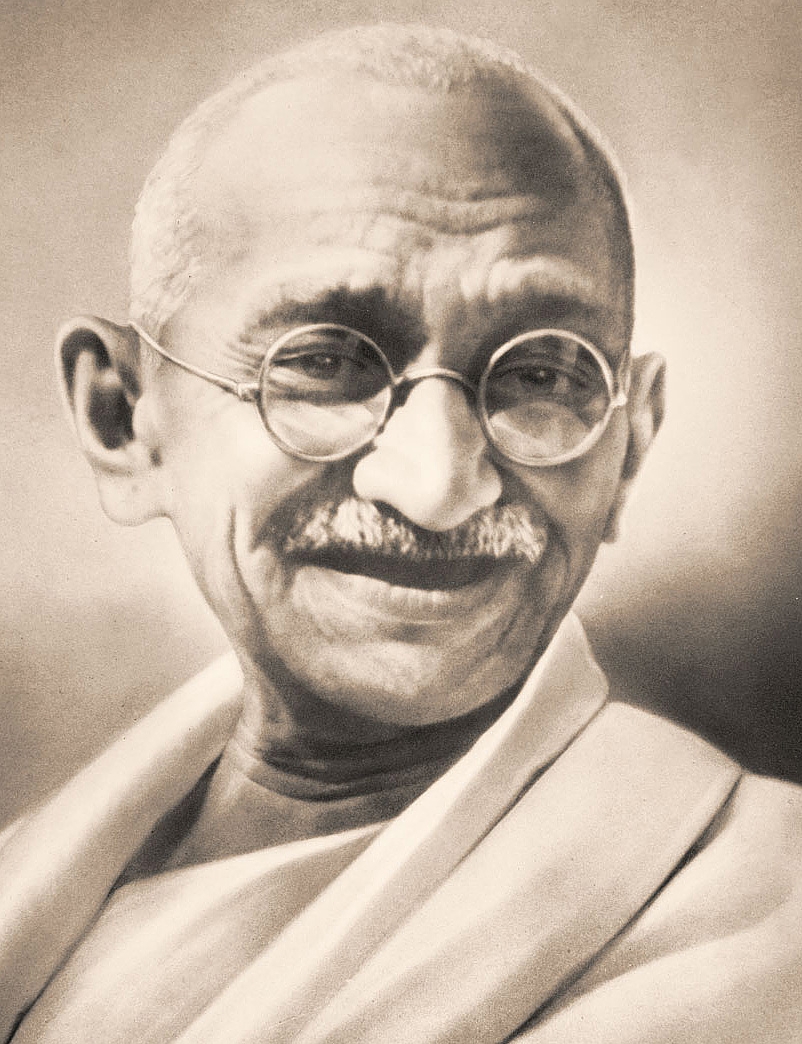
Mahatma Gandhi


Hi people!


This post is going to about one of the (possibly the most) important and most respected leaders in our society who used non violence as his main tactic, and inspired a countless amount of leaders to follow in his footsteps and spread the message of peace and unity throughout the world.


Yes, that beloved leader is Mahatma Gandhi.

Gandhi was a political and spiritual leader for India during the early 20th century. During that time, India was under British rule, and Indians were kept mostly as farm laborers or in other small jobs, living under the harsh reality of class discrimination. Indians faced heavy racial discrimination from the British, and were treated like they were nothing more than animals. Other than racial discrimination and colonial rule, Indians were also faced with unfair taxation, just as the colonists had to face in the 1700s.

Back to info on Mahatma Gandhi. His real name was Mohandas Karamchand Gandhi, and he was born in Porbandar, India, in 1869. His parents were devoted followers of Hinduism and they thought their son certain values and morals from the religion that later became some of Gandhi's trademarks. Some of these were vegetarianism (whoo hoo!), non-violence towards any other living beings, fasting for spiritual purification, and tolerance towards people with different racial and cultural backgrounds. At age 18, Gandhi went to school in London to become a barrister. In 1893, he accepted a job in Natal, South Africa. This was where Gandhi got a his first taste of discrimination against Indians. South Africa had a very high Indian population at the time, but they were treated extremely unfairly, sometimes even with violence. Gandhi was aboard a train in South Africa, and he had bought a ticket for second class. But, a white conductor confronted him and threw him out of the train just because he was an Indian.

For the next 21 years, Gandhi led the Indian population in peaceful protest against the government's attacks on their civil rights. These tactics landed thousands of Indians, including Gandhi himself, in jail, but these Indians eventually found widespread support, and that led to limited rights for Indians in South Africa.

In 1915, Gandhi returned to India, and quickly became the face of the Indian Independence Movement, a prolonged struggle for freedom from the British Empire. Gandhi went to work immediately, and led strikes against British landowners, drew out petitions, and directed efforts to clean up India's slums and poor villages. Once, when Gandhi was thrown in jail, hundreds of Indian supporters came to fight agianst this, and Gandhi was released. The British also agreed to repeal some of the taxes that were imposed during a food shortage, along with more rights and better wages for Indian workers.

This victory made Gandhi even more popular among the Indian people. People began to call him Bapu, which means Father, and Mahatma, which means pure or great soul. But, India remained under British rule, and Indians were still faced with a lot of oppression. Gandhi discarded western clothing, and only wore a dhoti, a simple white loincloth worn by India's poorest. In 1921, Gandhi was given the leadership of the Indian national congress. Gandhi, over the next 27 years, led various campaigns against British rule. One was the policy boycotting foreign made goods. Another was the famous salt march protesting the tax on salt, where Gandhi led thousands of Indians on a 23 day walk to the coast, where they made their own salt form sea water. Then there was his 21 day fast where he protesting the unfair treatment of untouchables, or the Indians who did very low work, like picking up garbage, cremating people, etc. The most famous of his movements was most probably the Quit India movement, where Indians refused to help the British in World War 2. The British responded with mass arrests, and Gandhi himself was locked up for two years.

The British finally gave in towards the end of the war, and on August 15th, 1947, Indians finally got their independence. Unfortunately, depsite Gandhi's efforts to keep the country as a whole, to settle disputes between the Hindus and Muslims, India was split into three; India, West Pakistan and East Pakistan. Less than six months later, Gandhi was assasinated by a Hindu extremeist who was unhappy about the settlement terms India had negotiated with Pakistan.

As you can see, the selfless, generous, and committed personality of Gandhi is truly inspirational, don't you think? as a result, he himself has inspired leaders all over the world! Some of these are Martin Luther King Jr. and Cesar Chavez.

Stay tuned for more posts on influential leaders!

A man who was completely innocent, offered himself as a sacrifice for the good of others, including his enemies, and became the ransom of the world. It was a perfect act.
~Mahatma Gandhi