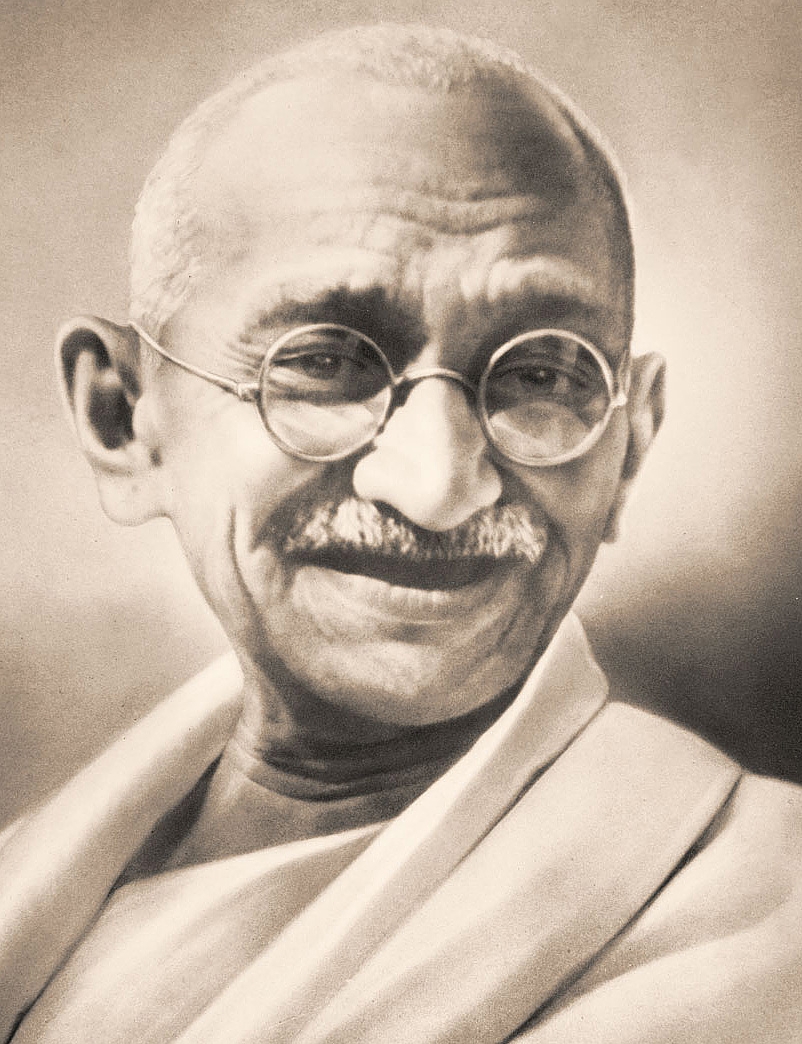
Hi people!
This post is going to about one of the (possibly the most) important and most respected leaders in our society who used non violence as his main tactic, and inspired a countless amount of leaders to follow in his footsteps and spread the message of peace and unity throughout the world.
Yes, that beloved leader is Mahatma Gandhi.
Gandhi was a political and spiritual leader for India during the early 20th century. During that time, India was under British rule, and Indians were kept mostly as farm laborers or in other small jobs, living under the harsh reality of class discrimination. Indians faced heavy racial discrimination from the British, and were treated like they were nothing more than animals. Other than racial discrimination and colonial rule, Indians were also faced with unfair taxation, just as the colonists had to face in the 1700s.
Back to info on Mahatma Gandhi. His real name was Mohandas Karamchand Gandhi, and he was born in Porbandar, India, in 1869. His parents were devoted followers of Hinduism and they thought their son certain values and morals from the religion that later became some of Gandhi's trademarks. Some of these were vegetarianism (whoo hoo!), non-violence towards any other living beings, fasting for spiritual purification, and tolerance towards people with different racial and cultural backgrounds. At age 18, Gandhi went to school in London to become a barrister. In 1893, he accepted a job in Natal, South Africa. This was where Gandhi got a his first taste of discrimination against Indians. South Africa had a very high Indian population at the time, but they were treated extremely unfairly, sometimes even with violence. Gandhi was aboard a train in South Africa, and he had bought a ticket for second class. But, a white conductor confronted him and threw him out of the train just because he was an Indian.
For the next 21 years, Gandhi led the Indian population in peaceful protest against the government's attacks on their civil rights. These tactics landed thousands of Indians, including Gandhi himself, in jail, but these Indians eventually found widespread support, and that led to limited rights for Indians in South Africa.
In 1915, Gandhi returned to India, and quickly became the face of the Indian Independence Movement, a prolonged struggle for freedom from the British Empire. Gandhi went to work immediately, and led strikes against British landowners, drew out petitions, and directed efforts to clean up India's slums and poor villages. Once, when Gandhi was thrown in jail, hundreds of Indian supporters came to fight agianst this, and Gandhi was released. The British also agreed to repeal some of the taxes that were imposed during a food shortage, along with more rights and better wages for Indian workers.
This victory made Gandhi even more popular among the Indian people. People began to call him Bapu, which means Father, and Mahatma, which means pure or great soul. But, India remained under British rule, and Indians were still faced with a lot of oppression. Gandhi discarded western clothing, and only wore a dhoti, a simple white loincloth worn by India's poorest. In 1921, Gandhi was given the leadership of the Indian national congress. Gandhi, over the next 27 years, led various campaigns against British rule. One was the policy boycotting foreign made goods. Another was the famous salt march protesting the tax on salt, where Gandhi led thousands of Indians on a 23 day walk to the coast, where they made their own salt form sea water. Then there was his 21 day fast where he protesting the unfair treatment of untouchables, or the Indians who did very low work, like picking up garbage, cremating people, etc. The most famous of his movements was most probably the Quit India movement, where Indians refused to help the British in World War 2. The British responded with mass arrests, and Gandhi himself was locked up for two years.
The British finally gave in towards the end of the war, and on August 15th, 1947, Indians finally got their independence. Unfortunately, depsite Gandhi's efforts to keep the country as a whole, to settle disputes between the Hindus and Muslims, India was split into three; India, West Pakistan and East Pakistan. Less than six months later, Gandhi was assasinated by a Hindu extremeist who was unhappy about the settlement terms India had negotiated with Pakistan.
As you can see, the selfless, generous, and committed personality of Gandhi is truly inspirational, don't you think? as a result, he himself has inspired leaders all over the world! Some of these are Martin Luther King Jr. and Cesar Chavez.
Stay tuned for more posts on influential leaders!
A man who was completely innocent, offered himself as a sacrifice for the good of others, including his enemies, and became the ransom of the world. It was a perfect act.
~Mahatma Gandhi

Really colorful, and pretty colors
ReplyDeleteLove the background!
ReplyDelete